Studio History
Overview
Guncaster's journey from concept to release wasn't a straight line. Over more than a year, the game went through three major reimaginations, survived multiple team shifts, and was guided at every turn by community feedback. This is the chronology of how studio behind Guncaster was founded, shipped, and why the team that built it chose to pursue different paths afterward.
Contributed Breakdowns
STUDIO HISTORY
Guncaster
A Boomer shooter fps where you fight enemies to regain the art of guncasting and your tower, featuring:
Fun and fluid movement system that lets players bounce off walls, dash around, and traverse their surroundings
Beautifully textured and stylized environment pieces to draw the whole game together
Hand made level modules that randomly generate to make each run unique
Diverse spell system with different spellcasting abilities, beware, your enemies can use it too
Dangerous enemy roster with engaging combat encounters for each zone
Scalable stats that let you become increasingly overpowered
An exhilarating multi-phase final boss encounter
Roguelite progression that carries stats between runs
Funny enemy voices and absurd ragdolls
Stunning music for both exploration and battle
Dynamic audio that reacts while you fight
A whooping 88% positive rating on Steam
But Guncaster wasn’t always like this
Timeline
Guncaster began as a 4-person team project in early 2024. The original concept followed a whimsical roguelite premise: a wizard armed with a gun exploring dungeons to reclaim his lost tower. The player would upgrade their abilities in a quirky mini-mall turned home base before venturing out into the dungeon. After a couple months of exploration and prototyping, the team decided to continue development and refine the vision.
Iteration 1
Guncaster’s humble beginnings
Following a brief break, the team regrouped with a clearer focus and began building a stronger foundation. It started with a fresh ideas and a blank canvas. The team evaluated progression and story and set off on production. This phase saw the introduction of entirely new systems, including a modular level snapping tool, a custom spellcasting framework, and fluid movement. Although progress was steady and productive, user feedback revealed that key gameplay elements still needed improvement. We took their feedback seriously, reshaping core systems based on what we learned.
Iteration 2
Guncaster testing out new ideas
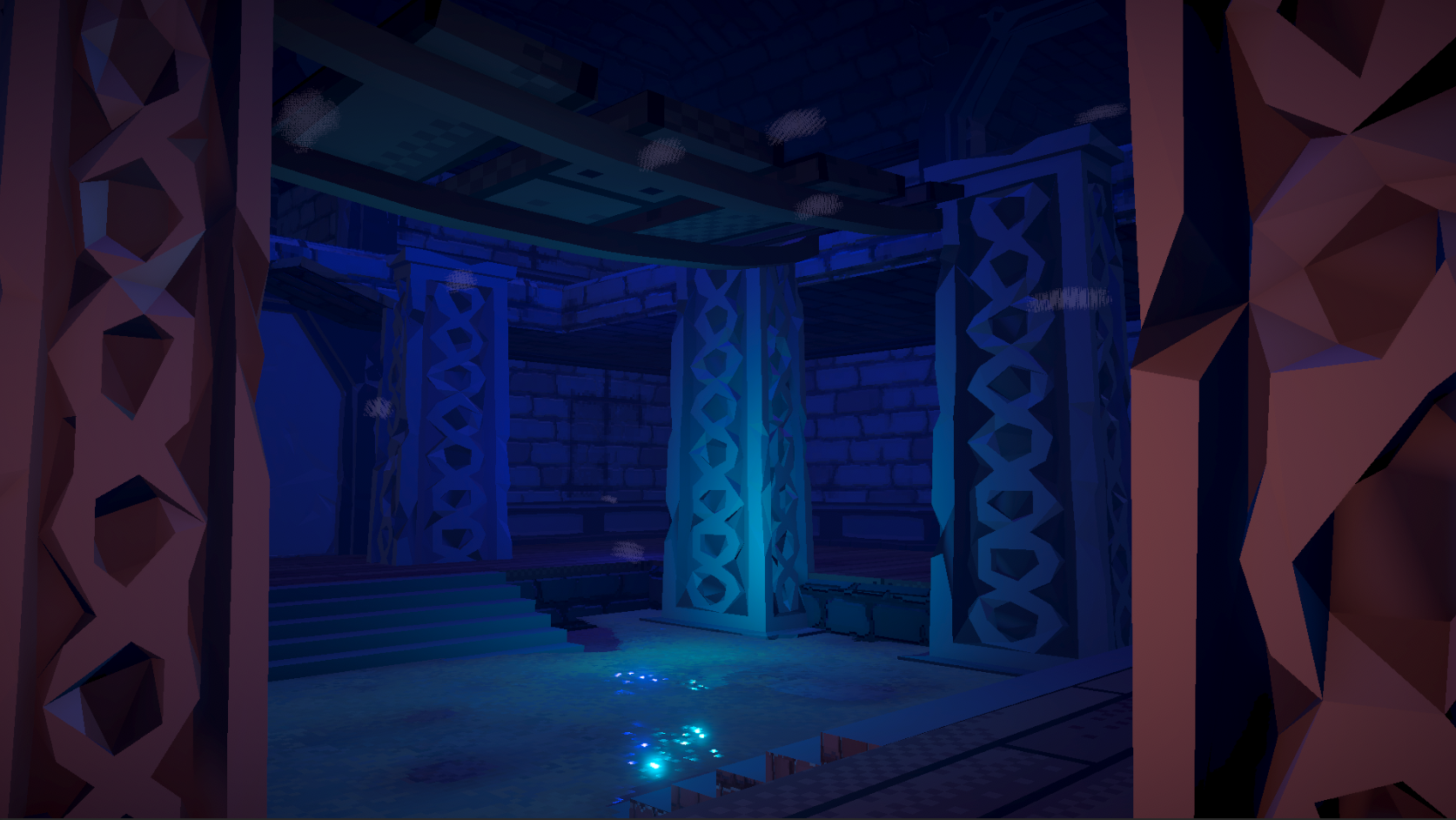
After a leadership shift and serious evaluation of our external feedback, the team entered a final stretch dedicated to refinement. Broken systems were rebuilt, rough mechanics were polished, and the game’s tone shifted to better align with player expectations. While the end product evolved far from the original concept, the result was a tighter, more engaging experience that resonated more strongly with its intended audience.
Iteration 3
Guncaster blossoming into a game
A history
Guncaster went through three major iterations during development, evolving drastically from concept to release. These changes were guided primarily by our community and their continued feedback throughout the process. They told us what worked, what didn't, and what they hoped for and we listened.
Act 1: The Idea
Grimoire Studios was the studio that Guncaster was published under. The founding of the studio can be majorly attributed to this reason, to combat the current state of the industry. Layoffs, AI shortcuts, and a lack of games as a creative aspiration. We felt like in some ways the games industry is being run by those who do not understand games but rather those who only want money. In an effort to make games as fellow artists we decided that we would bet on ourselves and establish a sustainable indie studio. The odds may have been low, but if facing the industry head on was the alternative we would have a better chance taking chance on ourselves
Grimoire Studios was conceptualized in January 2024 with the birth of Guncaster. We were a simple team, only four large, and we wanted to make a simple roguelite with silly tropes and addictive gameplay. The team was: myself, Kay Blake, Brian Tromba, Xander Hacking. After developing Guncaster’s prototype and getting decent reception from its pitch we decided to continue this idea.
Act 2: The Foundation
Starting around August 2024 Guncaster’s real development started. In addition to this, the core team expanded slightly and we all split into designated roles. Now the team was: myself as designer, Kay Blake as artist, Lauren Sterling as systems programmer, Brian Tromba as AI programmer, and Xander Hacking as character controller and leadership.
We decided that when the game shipped we wouldn’t charge anything hefty and would go for something simple like $5-$10. With a team, an idea, and a passion it was time to earnestly work.
While we all worked on Guncaster, sometimes dipping into areas we weren’t designated for out of necessity, things seemed to be proceeding smoothly. However, around winter things changed.
In late 2024 Brian had to step away from the project for personal reasons. This left a void in our team structure which I ended up filling. It was also around this time that Xander was having difficulties contributing to the project and as such he stepped down from his leadership position and into leaving Kay to pick up slack and handing me more programming responsibility. Now our two resident artists were busy double handling both their original designations as well as the work of others.
Thankfully our community support was becoming a lot more prevalent. Our community was constantly giving us pointers, telling us where we could improve. While the work to come was hectic we were able to rely on our community for feedback from here onward which was invaluable for tweaking gameplay.
To round off the year we officially founded Grimoire Games as our publishing LLC, It took a while for the paper work to get done and licensing constraints forced us to rebrand to Grimoire Studios.
Entering into 2025 and our final months of Guncaster things had to improve. The project really took off under Kay’s leadership and although I was split between three responsibilities I was very pleased with how things turned out. While working through these sprints, talks about the future of Grimoire Studios were also happening.
Act 3: The Fall
Entering into 2025 and our final months of Guncaster things had to improve. The project really took off under Kay’s leadership and although I was split between three responsibilities I was very pleased with how things turned out. While working through these sprints, talks about the future of Grimoire Studios were also happening.
We held several meetings making plans to form a concrete team after Guncaster’s development while discussing what things would look like later. The business model was sound on paper. We would work on two projects at all times and focus client work when available. Reputation would be built from our personal releases and revenue would come from client. To get things started first we’d ship Guncaster and use that success as a foundation, immediately pivoting to form the teams for developing our two titles and searching for contracts projects to stabilize cash flow.
The structure, however, was the problem. The ownership was split between developers and management, with a proposed profit division that heavily favored the management side. In other words individuals who would not be contributing directly to development would be taking a hefty portion of profits. For a small team where everyone had already invested months of unpaid or underpaid work, this felt unjust especially since future endeavors would yield similar results. The developers pushed back. We couldn't accept a model where effort and reward were so misaligned, especially when the management structure added overhead for a small indie studio without adding creative or technical value to the work.
Act 4: Moving On
Unable to reconcile these positions, Grimoire Studios dissolved shortly after Guncaster shipped. The aligned vision that carried us through development couldn't survive the transition into a sustainable business model. Kay and I chose to pursue Sister's Shadow separately, working to build a new studio with clearer ownership, equal contribution expectations, and shared equity that actually reflected the work being done.